Actualités du produit


Oct. 21, 2026
When a flour mill produces more flour than its packaging line can handle, finished products start waiting in storage, labor costs rise, and inconsistent bag weights create problems for distributors. Choosing the right flour packing machine helps wheat and maize flour producers coordinate weighing, filling, bag closing, and material handling. This guide explains how to select an FB Quantitative Packing Machine, compare automatic and semi-automatic systems, and evaluate a flour weighing and bagging machine based on production requirements, load cell technology, PLC control, and gravimetric dosing principles.
A flour packing machine is industrial equipment designed to measure a specified quantity of flour, fill packaging bags, and prepare finished packages for storage or distribution. Depending on the configuration, a flour packaging line may include a feeding hopper, bagging scale, bag-closing equipment, conveyor, dust collection system, and automatic palletizing equipment.
Unlike free-flowing granular products, flour is a fine powder that can become airborne, compact during storage, or change its apparent volume as air enters or leaves the material. These characteristics affect feeding stability and weighing consistency. A suitable industrial flour bagging machine must therefore match the flour's flow behavior, required package weight, and operating conditions.
Common applications include packaging wheat flour, maize flour, corn flour, whole wheat flour, cassava flour, rice flour, and other milled powder products. The appropriate machine depends on the product, packaging format, production target, and required level of automation.
Although individual designs differ, a typical flour weighing and bagging process follows a sequence of controlled operations.
Flour feeding: Flour moves from a storage hopper or conveying system into the packing machine's feeding section. A stable supply helps prevent interruptions during filling.
Quantitative weighing: A weighing system measures the flour against a preset target. Depending on the machine design, the system may use a weighing hopper, load cells, and an electronic weighing controller.
Bag positioning: An operator or automatic bag-handling mechanism positions and secures an empty bag beneath the filling outlet.
Filling: The machine releases the measured flour into the bag. Feeding speed and cutoff timing must be adjusted to the material's flow characteristics.
Bag closing: The filled bag moves to a sewing, heat-sealing, or other suitable closing station according to the packaging material and bag design.
Conveying and stacking: A conveyor transfers finished bags to the next operation. Larger or more automated installations may incorporate checkweighing, bag handling, and robotic palletizing.
The key engineering principle is coordination. A high-speed weighing unit cannot deliver its full production potential if bag positioning, sewing, or downstream conveying becomes the bottleneck.
A semi-automatic flour packing machine automates weighing and filling while retaining some manual tasks, such as placing empty bags or transferring packages. It can be suitable for mills that need controlled bag weights without investing in a fully automated packaging line.
Typical application: Small and medium-sized flour mills, flexible production operations, and facilities with moderate packaging demand.
Main advantage: Operators retain control over bag handling while the weighing system standardizes filling.
Key consideration: Actual throughput depends on operator speed, bag changes, filling cycles, and the performance of the bag-closing station.
Pingle's automation packing equipment range includes the PLBZD Semi Automatic Packing Machine and the FB Quantitative Packing Machine, which is specifically listed for flour weighing and packaging.
An automatic flour packing machine integrates more operations into a coordinated system. Depending on the configuration, automatic bag handling, weighing, filling, sewing, conveying, and palletizing can reduce repetitive manual work and improve production consistency.
Typical application: Flour mills with sustained production volumes, standardized packaging formats, and limited tolerance for manual handling delays.
Main advantage: Coordinated equipment can reduce labor requirements and support continuous production.
Key consideration: Confirm the complete line's rated output rather than relying on the speed of the weighing unit alone.
Bag weight is one of the most important selection factors. Retail packs, medium-sized bags, and large commercial sacks require different handling arrangements and may use different filling technologies.
| Packaging Requirement | Equipment Considerations | Important Purchasing Question |
|---|---|---|
| Small retail packages | Package forming or pouch handling, precise dosing, and suitable sealing | Can the machine maintain the target weight at the required pack rate? |
| Medium-sized flour bags | Weighing and filling, bag positioning, and reliable bag closure | How quickly can the operator or automatic system change bags? |
| Large commercial sacks, such as 25 kg or 50 kg bags | Quantitative weighing, secure bag support, sewing or other suitable closure, and conveying | Can the complete line handle the target weight and daily production volume? |
These are packaging categories, not guaranteed machine specifications. Always confirm the permitted weighing range and compatible bag formats for the selected model.
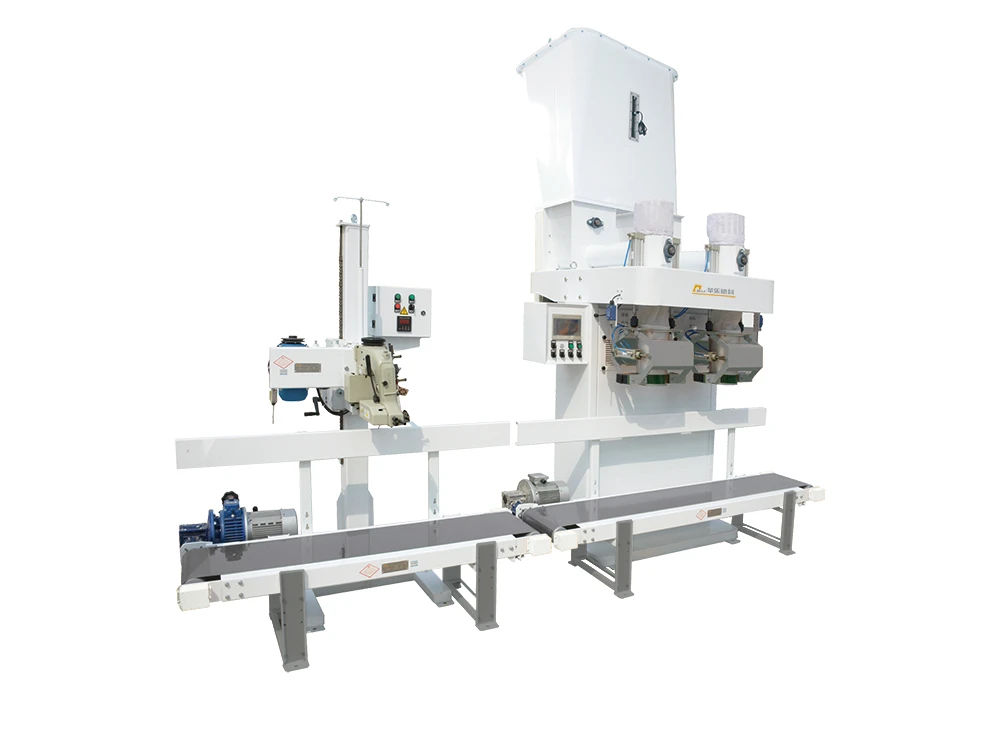
The hopper provides a controlled supply of flour to the weighing or dosing section. Hopper geometry, outlet dimensions, and feeding method influence how consistently the powder moves through the system. Flour that bridges or compacts may interrupt feeding, so the equipment should be tested with the actual product.
A load cell converts applied force into an electrical signal that can be interpreted as weight. The weighing controller processes the signal and helps regulate the filling cycle. Correct installation, calibration, vibration control, and stable machine support all contribute to reliable measurement.
For purchasing evaluations, request actual test results at the intended bag weight. Ask the supplier to distinguish weighing resolution, repeatability, and allowable filling error instead of treating them as interchangeable specifications.
A programmable logic controller (PLC), when included in the machine configuration, coordinates operating sequences and equipment interlocks. An operator interface can simplify target-weight adjustments, production monitoring, and fault identification.
For mills handling several flour products or bag formats, check whether recipes and operating parameters can be stored and recalled. Also ask which settings require authorized adjustment and how operating faults are displayed.
Bag-closing equipment must match the packaging material and intended distribution conditions. Open-mouth paper or woven bags may use industrial sewing equipment, while compatible film packaging may require heat sealing. Flour dust around the bag mouth can interfere with closure quality, so filling and closing should be evaluated together.
Pingle lists the TFK Sewing Machine as equipment matched with its FB series quantitative packing machine for sewing and transporting filled bags to the next process.
A conveyor transfers filled bags between stations, while dust collection helps capture airborne flour around relevant transfer and filling points. Depending on the production layout, an integrated line may also include automatic stacking or robotic palletizing.
Flour dust management is a safety requirement as well as a housekeeping concern. Fine organic dust can create a combustible atmosphere under suitable conditions. The installation should therefore incorporate appropriate dust extraction, ignition-source control, grounding where required, and compliance with applicable local combustible-dust and food-processing safety requirements.
Start by specifying whether the machine will package wheat flour, maize flour, whole wheat flour, or another powder. Different products may have different bulk densities, moisture contents, particle-size distributions, and flow behaviors.
These properties influence filling speed and weight consistency. Ask the supplier whether product samples are required for testing and whether different flour types need separate settings or mechanical adjustments.
List every bag size the machine must handle, including the target net weight, bag dimensions, material, and closing method. If a mill primarily packs 25 kg flour bags but occasionally produces 50 kg bags, confirm that both formats are supported before assuming one machine can handle them.
Also consider the bag supply method, available headroom, floor space, and the distance between filling, closing, and finished-product storage.
Use actual production requirements rather than choosing equipment based only on a supplier's headline speed.
Required average bagging rate:
Required bags per minute = Daily packaging volume (kg) ÷ Bag weight (kg) ÷ Net operating minutes per day
For example, a flour mill packaging 80 tonnes per day into 25 kg bags needs to complete 3,200 bags daily. If the line has 16 net operating hours, the required average rate is 200 bags per hour, or approximately 3.3 bags per minute.
This is an illustrative capacity calculation, not a measured machine performance result. The selected line needs sufficient additional capacity to account for bag changes, cleaning, maintenance, production interruptions, and downstream bottlenecks.
Small filling errors can accumulate into significant material losses across thousands of bags. For instance, an average overfill of 50 g on 3,200 bags represents 160 kg of additional flour per production day.
To evaluate performance, request a trial using the intended flour and bag weight. Record the actual weight of a representative sample of filled bags, calculate average deviation from the target, and examine the spread of results. Confirm that the proposed acceptance limits comply with the applicable net-quantity regulations in the destination market.
Do not compare machines using accuracy percentages alone unless the measurement basis, operating conditions, and test method are equivalent.
Compare the labor requirements and operating sequence of a semi-automatic flour packing machine with those of a fully integrated line. A semi-automatic setup may be practical when production demand is moderate and labor is readily available. Automatic bag handling, sewing, and palletizing may become more valuable when the mill operates for extended shifts or handles a large daily volume.
Evaluate the output of the entire system, including bag closing and conveying. Ask how the line behaves during changeovers, minor faults, and restarts, rather than focusing only on its best-case filling speed.
Confirm that product-contact materials are appropriate for food processing and that accessible surfaces can be cleaned effectively. Inspect the filling outlet, weighing hopper, seals, and dust extraction points for areas where flour may accumulate.
Request a maintenance schedule, a recommended spare-parts list, and details of the service support available in your region. Check how load cells, sensors, sewing components, and other wear parts can be inspected or replaced.
Where possible, arrange a factory acceptance test using representative flour, actual bags, and the intended target weight. Record the following results:
Average bag weight and variation across the test sample.
Completed bags per minute under stated operating conditions.
Bag-closing quality and the frequency of rejected packages.
Dust leakage around filling and transfer points.
Changeover time, operator requirements, and routine cleaning access.
Agree on the test procedure and acceptance criteria before the trial. A documented test is more useful for purchasing decisions than an unqualified claim of high speed or high precision.
Consider a flour mill that produces several grades of wheat flour and needs to package 25 kg bags for wholesale distribution. The plant manager wants to reduce waiting time between milling and dispatch without installing unnecessary automation.
A practical evaluation would begin with the daily packing target, the number of available operating hours, and the required bag-closing method. The manager would then compare the FB Quantitative Packing Machine with other suitable configurations, confirm whether the existing labor arrangement can support manual bag positioning, and determine whether the TFK Sewing Machine and a conveyor would meet the downstream requirements.
The capacity calculation establishes the minimum average output. A product trial then checks whether the selected equipment can consistently reach that rate while meeting the required net weight and bag-closing standards. If sewing becomes the bottleneck, upgrading the weighing unit alone will not solve the production problem.
This example illustrates a planning method rather than a claim about a particular customer installation. Final equipment selection should follow verified production data and machine testing.
| Problem | Possible Cause | Practical Response |
|---|---|---|
| Inconsistent bag weights | Changing flour flow, incorrect calibration, vibration, or unstable feeding | Check calibration, inspect the feeding mechanism, and repeat weight tests under normal operating conditions. |
| Flour dust escaping during filling | Incorrect bag positioning, unsuitable filling geometry, or inadequate extraction | Inspect the filling connection, bag support, and dust collection arrangement. |
| Flour bridging in the hopper | Powder cohesion, unsuitable hopper geometry, or changing material conditions | Review the hopper design and feeding method with the equipment supplier. |
| Weak or incomplete bag closure | Flour contamination at the bag mouth, unsuitable closing settings, or worn components | Inspect the closure area and verify sewing or sealing settings against the packaging material. |
| Lower-than-expected output | Slow bag positioning, frequent changeovers, downstream congestion, or unplanned stops | Measure cycle times across the entire line and identify the operation limiting throughput. |
Bulk density is the mass of flour occupying a given bulk volume, including the spaces between particles. It can change with aeration, handling, and material characteristics. Volumetric filling systems may therefore need more frequent adjustment when density changes, while weighing-based systems still require stable feeding and appropriate calibration.
Instead of checking only whether a bag appears full, record measured weights throughout a production run. Calculate the mean weight and standard deviation of the sample to identify systematic overfilling or increasing variation. Repeat checks after product changes, setup adjustments, or maintenance.
Where the machine supports it, use the results to fine-tune filling parameters without compromising legal net-weight requirements.
Measure the time needed for bag placement, filling, removal, sewing, and transfer. The slowest operation often determines the practical line output. Coordinating the filling cycle with the bag-closing system can improve throughput more effectively than increasing one machine's speed in isolation.
Purchase price is only one part of the investment. Compare labor requirements, energy consumption, maintenance costs, spare parts, expected downtime, cleaning time, and flour giveaway. A higher level of automation is worthwhile when its measurable operating benefits justify the additional capital and maintenance requirements.
The right machine depends on the flour type, target bag weight, daily packaging volume, available labor, and bag-closing requirements. A semi-automatic quantitative packing machine may suit moderate production demand, while a coordinated automatic line may be more appropriate for high-volume operations.
Some machines can handle both products, but compatibility should be confirmed with the manufacturer. Differences in bulk density, flow behavior, and particle characteristics may require adjustments or product-specific testing.
An FB Quantitative Packing Machine is a flour weighing and packaging product listed in Pingle's automation packing range. It is designed for quantitative flour packaging. Buyers should confirm the selected model's weighing range, bag compatibility, output, and integration requirements with Pingle before placing an order.
A weighing machine measures a specified quantity of flour. A flour packing machine combines weighing with filling and may also work with bag-closing and conveying equipment. A complete packaging line can extend these functions to automatic bag handling and palletizing.
Consistent weighing can reduce unnecessary overfilling, while suitable bag positioning and dust collection can limit product loss during filling. The actual savings depend on the initial level of overfill, the number of bags packed, and the results achieved after optimization.
That depends on the packaging design and machine configuration. Open-mouth bags that require stitching may need a compatible sewing unit. Pingle lists its TFK Sewing Machine for use with the FB series quantitative packing machine, allowing filled bags to be sewn and transported to the next process.
Provide the flour type, target bag weights, bag dimensions and materials, daily output, available operating hours, desired automation level, closing method, factory power supply, and installation conditions. If possible, include a sample bag and representative flour sample so the supplier can assess compatibility and recommend a suitable configuration.
Selecting the right flour packing machine means matching the equipment to the mill's real production requirements, not simply choosing the fastest or most automated model. Accurate weighing, stable feeding, suitable bag sewing, effective dust extraction, and coordinated conveying all contribute to a dependable flour packaging operation.
Pingle has worked in grain processing since 1991 and states that it has supplied and served more than 1,000 large and medium-sized flour milling plants. Its automation packing range includes the FB Quantitative Packing Machine, PLBZD Semi Automatic Packing Machine, PLDM Hopper Scale, TFK Sewing Machine, and other packaging and palletizing equipment.
If you are evaluating a flour packaging equipment supplier, prepare your target bag weights, daily output, and preferred level of automation before requesting a quotation. Contact Pingle to discuss a suitable flour bagging system for your milling plant, including quantitative weighing, PLC-based monitoring where applicable, bag sewing, dust extraction requirements, and downstream palletizing options.